
Potty Watches and Timers: Do They Work?
Yes, they work — for the right problems. Potty watches fix two things: inconsistent reminder timing, and the power struggle dynamic. When the watch tells a child to go instead of a parent, compliance often jumps significantly. They're not magic, but for most kids, they're a genuine accelerant.
📋 Jump to Section
What a Potty Watch Actually Does
A potty training watch is a wearable timer the child wears on their wrist. It sounds an alarm (beep, melody, or vibration) at preset intervals — typically configurable from 30 to 90 minutes. When the alarm sounds, the rule is: we try to use the potty.
That's it. It's not tech magic. But the mechanism matters:
- It removes the parent from the enforcement role
- It creates consistent intervals regardless of how distracted the parent or child is
- It gives the child ownership of a tool ("my watch") rather than being told what to do
- It creates a predictable, external cue the child's brain can start associating with the behavior
Habit formation requires consistent cues. A parent who sometimes forgets, sometimes reminds at different intervals, and sometimes backs off during play creates inconsistent cueing — which slows habit formation significantly. A watch is perfectly consistent.
Why They're Particularly Effective
Two problems in potty training are solved almost entirely by the watch:
Problem 1: The power struggle dynamic. "You need to go potty." "No." "Yes you do." "NO." This is a common pattern that has nothing to do with the potty and everything to do with autonomy. When the watch beeps, the answer to "why do I have to go?" isn't "because I said so" — it's "because your watch said so." Toddlers who will fight parental direction on principle often comply immediately when an external authority delivers the cue. Not a joke — this genuinely works for a majority of kids.
Problem 2: Parental inconsistency. Life is busy. Parents forget to remind. They remind at random intervals. Some days they're vigilant; some days they're distracted. This inconsistency extends training. A watch set for 60 minutes and left on the child's wrist is consistent every day, all day, without parental management overhead.
Bonus effect: Kids who wear a potty watch often engage more with the process because they have something to own. "My potty watch" is interesting to a toddler. Interest sustains engagement. Engagement produces practice.
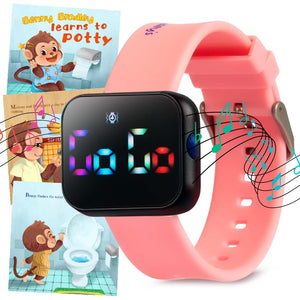
Benny Bradley's Potty Training Watch
The most-referenced potty watch on the market. Kid-friendly design, multiple color options (so the child can pick), adjustable intervals from 30-90 minutes, and a simple setup that parents can configure in 2 minutes. The V2 is waterproof and holds up to actual toddler use.
View on Amazon →How to Use a Potty Watch Correctly
The watch only works if you use it right. These are the most common mistakes:
The right setup:
- Set the interval based on your child's current bladder capacity — start at 60 minutes, adjust to 90 as progress is made
- Let the child put it on themselves if possible — more ownership
- Establish the rule clearly before starting: "When the watch beeps, we go try. Every time."
- Keep the rule consistent — the value is in the consistency, not the individual trips
Common mistakes:
- Overriding the watch — "Just go one more minute, we're almost at the park." Don't do this. The exception undermines the rule.
- Setting intervals too short — 30-minute intervals burn out both parent and child. 60 minutes is a better starting point for most 2-3 year olds.
- Taking the watch off for "convenience." Keep it on. The consistency is the point.
- No actual sit requirement. The watch beeped, they need to sit and try — not just acknowledge and continue playing.
The watch is a prompt, not a guarantee. When the alarm sounds, you still go with them, provide any needed assistance, and celebrate successes. The watch automates the timing; you still manage the process.
When Potty Watches Don't Help
Potty watches are a tool, not a solution to every problem. They're less useful when:
- The child isn't ready. A watch won't make an unready child ready. If readiness signs aren't there, the watch just produces conflict at 60-minute intervals.
- Fear is the primary issue. A child who's afraid of the toilet needs desensitization work, not a reminder watch. The watch prompts them toward something scary — that's counterproductive.
- Genuine defiance with the watch itself. Some kids will simply refuse to respond to the watch the same way they refuse everything. In this case, the power struggle issue needs addressing first.
- Night training. Watches aren't designed for overnight use and won't help with nighttime dryness, which is a physiological issue.
What to Look for in a Potty Watch
Key features that distinguish useful watches from novelties:
- Adjustable intervals: Fixed 60-minute watches aren't useful as your child progresses. Look for 30-90 min adjustability.
- Kid-proof construction: Toddlers are hard on things. Look for waterproof, impact-resistant build.
- Simple interface: The child should be able to see when it beeps without needing to do anything complex.
- Color options: Letting the child choose their watch color increases buy-in significantly.
- Comfortable band: Soft, adjustable wristband that fits 2-4 year olds. Many cheap watches have stiff bands kids won't tolerate.
- Good battery life: Changing batteries constantly is annoying. Look for 3+ month battery life.